
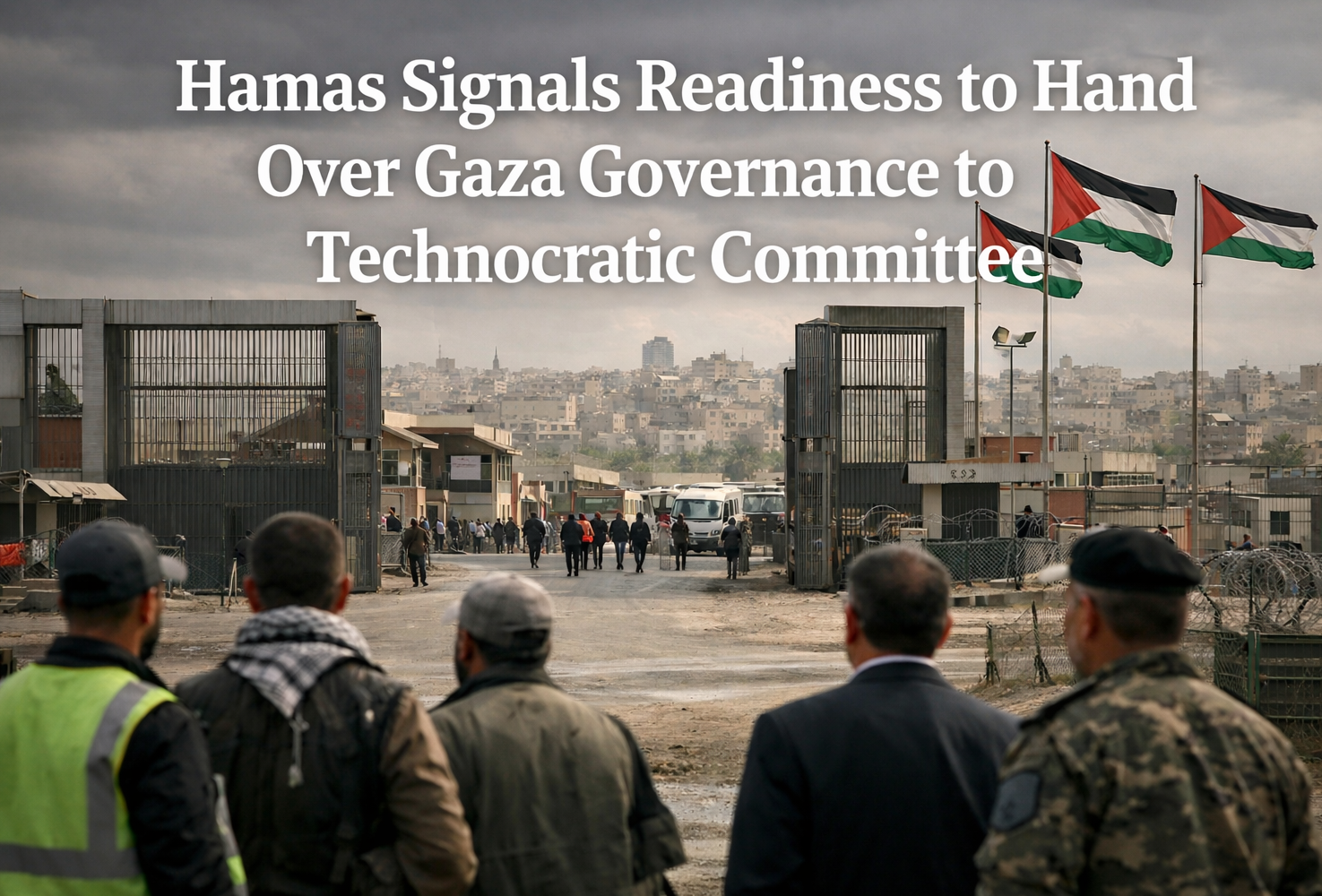
DEIR BALAH: Hamas has announced it is prepared to transfer governance of the Gaza Strip to a Palestinian technocratic committee, as long as the Rafah border crossing is fully reopened without restrictions in the coming days.
Hamas spokesperson Hazem Qassem said on Wednesday that all administrative preparations for the handover have been completed, including governance protocols, documentation, and oversight committees. He said the move would allow a “complete transfer of governance across all sectors” in Gaza to an independent technocratic body.
The transfer is linked to the establishment of the National Committee for the Administration of Gaza (NCAG), a 15-member team of Palestinian technocrats formed under a US-sponsored ceasefire agreement that came into force on October 10. The committee is tasked with managing Gaza’s day-to-day civilian affairs in the post-war phase and will operate under the supervision of an international “Board of Peace”.
According to Hamas, the NCAG will begin its work once the Rafah crossing on Gaza’s border with Egypt is reopened. The committee is headed by former Palestinian Authority deputy minister Ali Shaath, who is expected to enter Gaza following the reopening.
Qassem stressed that the Rafah crossing must be opened “in both directions, with full freedom of movement, without Israeli interference.” Rafah remains Gaza’s only border crossing that does not connect directly to Israel and serves as a critical route for civilians, humanitarian aid, and commercial goods.
Israeli forces took control of the crossing in May 2024, leading to its closure for most of the past year. A brief reopening in early 2025 was limited, and previous attempts to fully restore operations failed.
Shaath announced last week that Rafah was expected to reopen in both directions within days. Hamas welcomed the announcement but emphasized that the committee’s actions must align strictly with the ceasefire agreement rather than Israeli conditions.
Hamas also reiterated its commitment to the ceasefire that ended large-scale hostilities in Gaza, which began after the October 7, 2023 attack on southern Israel. Qassem said the group had fulfilled all obligations under the first phase of the agreement and was ready to proceed with the second phase.
With the formation of the technocratic committee and the return of the final Israeli prisoner held in Gaza, the next critical steps under the ceasefire framework include Hamas’s disarmament and Israel’s withdrawal from the territory.
While Hamas has not yet surrendered its weapons, it has signaled openness to transferring arms to a future Palestinian governing authority, despite repeatedly describing disarmament as a “red line.” No firm timeline has been announced by either side regarding weapons handover or Israeli troop withdrawal.