
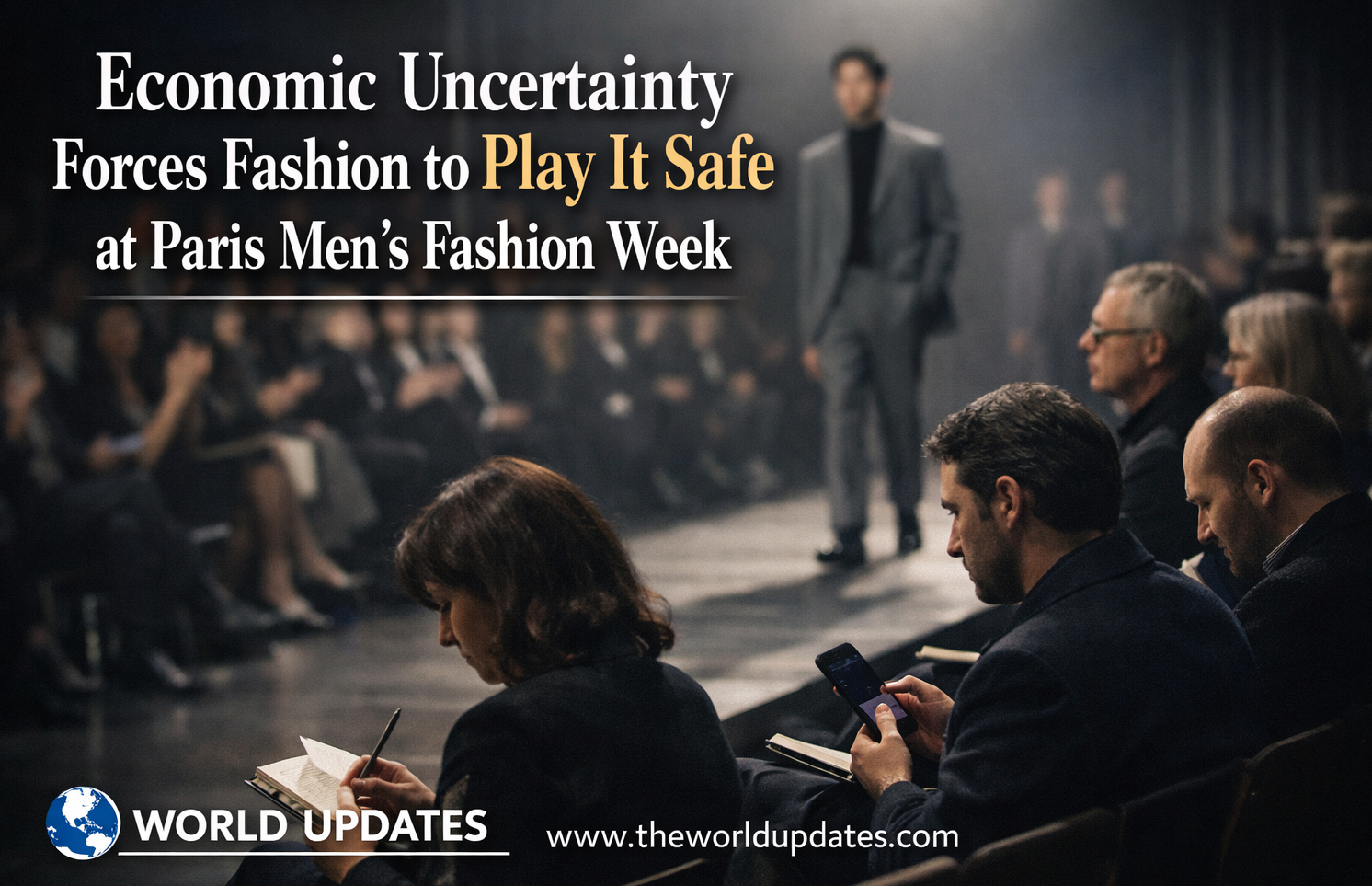
PARIS: Paris Men’s Fashion Week is opening against a backdrop of global economic strain, pushing luxury labels toward safer, more commercially focused collections after years of uneven performance across key markets, particularly in China.
Unlike recent seasons dominated by headline-grabbing creative shake-ups, this year’s menswear schedule reflects consolidation rather than upheaval. Many fashion houses are now giving recently appointed designers time to refine their identities, signaling a pause after a period of rapid change at the top.
Last October’s womenswear shows described by some insiders as historic introduced new creative leadership at several powerhouse brands, including Matthieu Blazy at Chanel and Jonathan Anderson at Dior. The mood in menswear, however, is noticeably more cautious.
Industry observers say prolonged economic pressure is reshaping creative decisions. Marie Ottavi, a fashion journalist at Libération, noted that designers are increasingly prioritizing wearability and sales potential over conceptual risk. According to her, collections are being designed to reassure consumers rather than surprise them.
That shift is also evident in retail. Franck Nauerz, who oversees menswear buying at Paris department stores Le Bon Marché and La Samaritaine, said predictability has become a defining feature of recent seasons. “Brands are trying to protect what works instead of pushing boundaries,” he explained.
End of an Era at Hermès
One of the defining moments of the week will come on Saturday, when Véronique Nichanian presents her final menswear collection for Hermès after nearly four decades leading the house’s men’s division.
Nichanian, a rare female figure at the highest level of menswear design, leaves behind a legacy of understated luxury and a brand widely admired for its financial resilience and timeless aesthetic.
Her successor, British designer Grace Wales Bonner, has already been confirmed and will take over in 2027. Known for weaving cultural heritage into modern tailoring, Wales Bonner is expected to bring a new perspective when she unveils her first collection.
Pressure Builds at Dior
Anticipation is also high for Dior’s latest menswear offering by Jonathan Anderson, whose second collection for the house will be revealed midweek. While his initial menswear debut was widely praised, his women’s designs last season divided opinion.
Now regarded as one of the most influential designers of his generation, Anderson faces the challenge of defining a long-term creative direction for Dior Homme. Buyers are watching closely. Alice Feillard, men’s buying director at Galeries Lafayette, said expectations are particularly high this season.
Newcomers Step Into the Spotlight
As some major brands scale back their presence, space has opened on the calendar for emerging and independent labels. French designer Jeanne Friot will stage her first official runway show after building momentum through presentations, bringing her socially conscious and inclusive approach to the main stage.
Italian designer Luca Magliano, winner of the Karl Lagerfeld Prize in 2023, will make his Paris runway debut, while ERL, KML, Sonia Carrasco, and Ssstein join the program in presentation format.
Meanwhile, Loewe has opted to showcase a unisex collection during Women’s Fashion Week later this year, while Saint Laurent has once again stepped away from the men’s calendar.
According to Feillard, these absences benefit established independent labels such as Lemaire, AMI, and American designer Rick Owens, which gain increased visibility as a result.
Japanese fashion heavyweights Issey Miyake and Yohji Yamamoto remain central to the Paris schedule, alongside French labels 3.Paradis and Egonlab.
The week will close with a high-profile show by Simon Jacquemus at the Picasso Museum, an event expected to attract celebrities and global media attention.
Despite the economic headwinds, Paris continues to anchor the global fashion calendar as part of the industry’s “Big Four,” alongside New York, London, and Milan a reminder that even in cautious times, the city remains a defining force in menswear.