
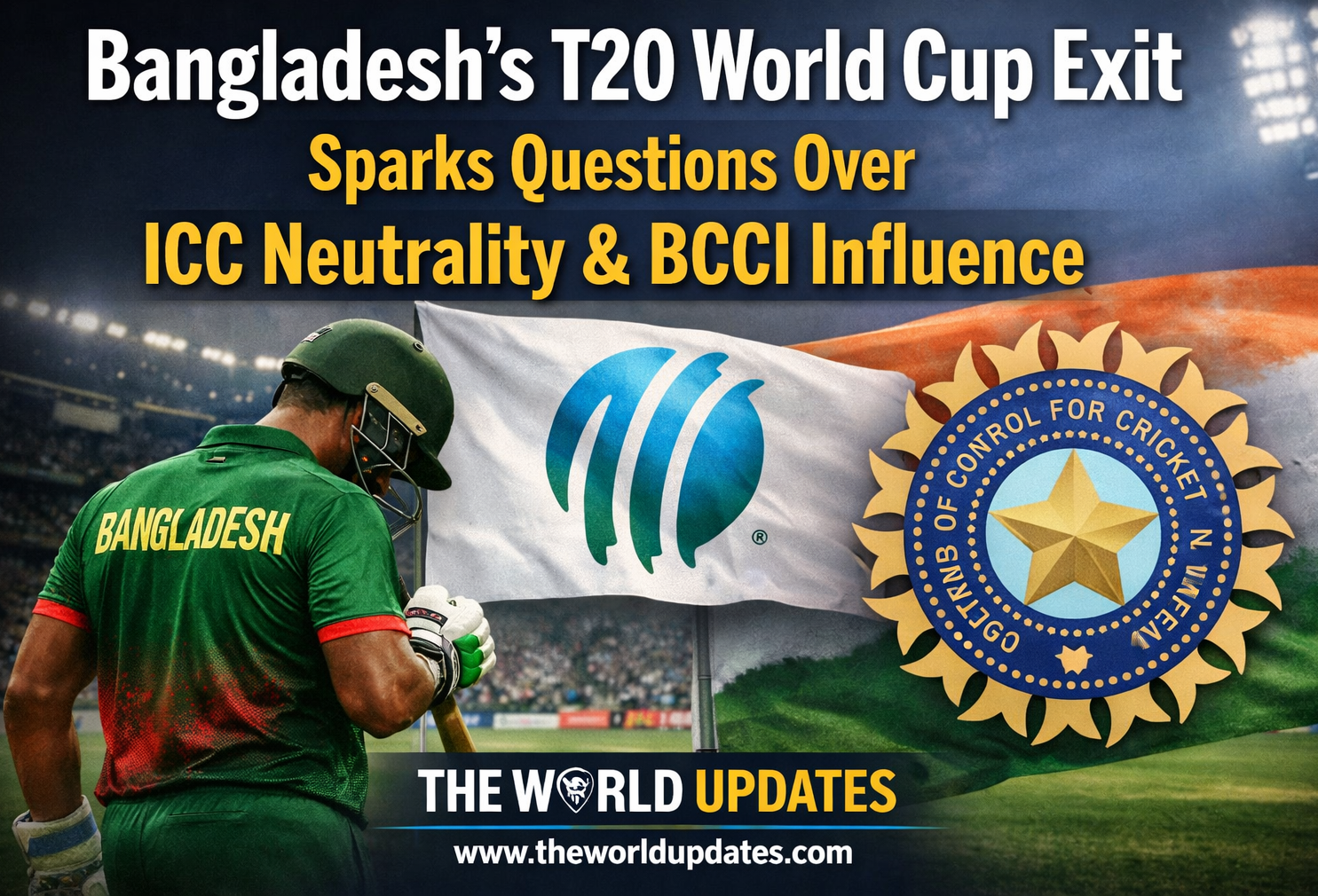
Bangladesh’s exclusion from the ICC Men’s T20 World Cup 2026 has triggered debate over the International Cricket Council’s decision-making process, with critics questioning whether India’s financial dominance in global cricket played a role in the outcome.
The controversy emerged after the Bangladesh Cricket Board (BCB) refused to play its World Cup matches in India, citing security concerns. The request for neutral venues was rejected by the International Cricket Council (ICC), which later confirmed Bangladesh’s removal from the tournament following the board’s refusal to comply.
Security Concerns Rejected
In a statement, the ICC said it had conducted an “elaborate assessment” and found “no credible or verifiable security threat” to Bangladesh’s players, officials, or supporters in India. As a result, the governing body insisted that Bangladesh must play its scheduled matches in the host nation.
The BCB’s position hardened after the Kolkata Knight Riders terminated the Indian Premier League contract of Bangladeshi fast bowler Mustafizur Rahman. The termination reportedly followed directions from the Board of Control for Cricket in India (BCCI), although no official explanation was issued.
Bangladesh officials viewed the situation as contradictory, noting that no Bangladeshi player featured in the IPL, while the national team was still expected to tour India for a global tournament.
Comparisons With India’s Pakistan Stance
The ICC’s handling of the Bangladesh request has drawn comparisons with its accommodation of India during the 2025 Champions Trophy. India declined to travel to Pakistan for the event, citing security concerns, and the ICC allowed its matches to be shifted to Dubai.
Observers have questioned why a similar accommodation was not extended to Bangladesh, with critics arguing that the ICC’s concern about setting a “precedent” appears selective.
Former Australia coach Jason Gillespie publicly raised the issue on social media, asking why Bangladesh was denied neutral venues when India had previously been granted the same concession. His post was later deleted after online backlash.
Financial Influence Under Scrutiny
The debate has also refocused attention on the ICC’s revenue-sharing model. Under the 2024–27 cycle, the BCCI receives approximately 38.5% of the ICC’s annual revenue — roughly $230 million — the largest share by any member board.
Industry estimates suggest that around 80% of ICC commercial revenue is generated from the Indian market. In 2024, the ICC signed a four-year broadcast deal with Disney Star worth a reported $3 billion, largely driven by Indian viewership.
Critics argue that this financial dependence limits the ICC’s ability to act independently when disputes involve Indian cricket interests.
ICC and BCCI Responses
BCCI secretary Devajit Saikia has denied any role in the matter, stating earlier this month that the issue falls outside the Indian board’s jurisdiction.
However, analysts maintain that the ICC’s governance structure makes it difficult to separate regulatory decisions from commercial realities, particularly when geopolitical tensions involving South Asian cricket boards are involved.
Wider Implications
The episode has intensified concerns over unequal treatment within international cricket and the ICC’s ability to maintain neutrality amid growing financial imbalances. While the ICC insists its decision was based solely on security assessments and tournament integrity, Bangladesh’s exclusion has added to calls for greater transparency and consistency in how such disputes are resolved.
For now, Bangladesh remains out of the 2026 T20 World Cup — a decision that continues to reverberate well beyond the cricketing field.