
Tournament featuring 20 teams delivers historic performances, explosive batting, and standout bowling displays
The ICC Men’s T20 World Cup 2026 concluded with a series of record-breaking performances, historic milestones, and thrilling matches that showcased the growing global popularity of the shortest format of cricket.
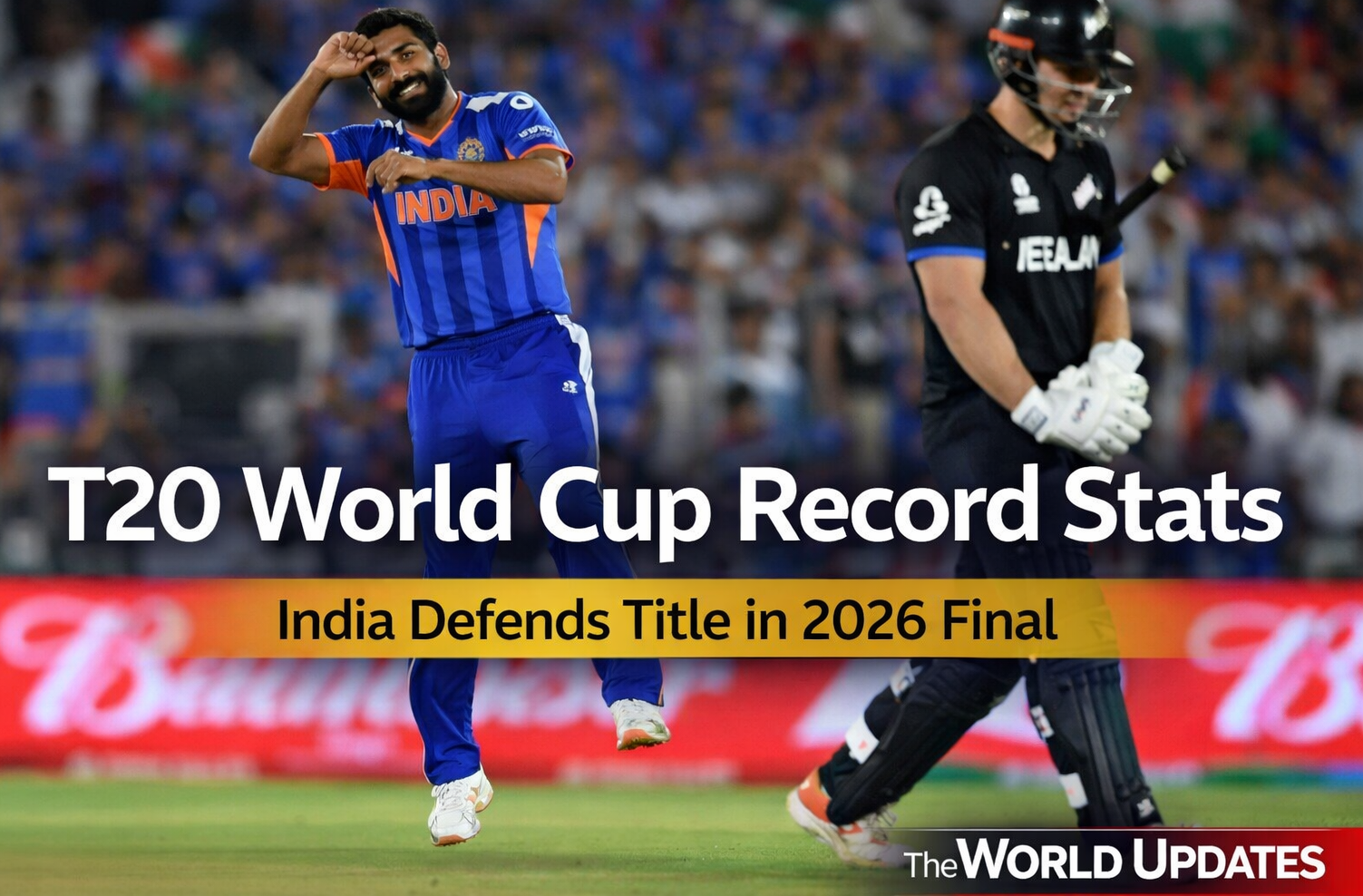
In the final held at the iconic Narendra Modi Stadium in Ahmedabad, defending champions India national cricket team defeated New Zealand national cricket team to successfully retain their title.
The 2026 edition of the tournament marked a historic expansion, with 20 teams competing and a total of 55 matches played, making it one of the largest and most competitive T20 World Cups in history.
Cricket analysts say the event highlighted the increasing dominance of aggressive batting and high-scoring games in modern T20 cricket.
Record-Breaking Run Scoring Across the Tournament
The tournament witnessed remarkable batting performances, with teams collectively scoring 17,582 runs across all matches.
Among these runs were 7 centuries and 86 half-centuries, reflecting the increasingly aggressive nature of T20 cricket.
One of the most remarkable statistics came during the closing overs of innings.
A total of 3,270 runs were scored in the final three overs of innings, demonstrating how teams continue to accelerate scoring during the death overs.
The first six overs, known as the powerplay, also produced impressive numbers.
Players scored 5,411 runs during powerplay overs, while 101 runs were scored on free-hit deliveries.
These figures highlight the intense attacking approach adopted by teams throughout the tournament.
Boundaries Dominate the Scoring Charts
The 2026 World Cup also saw an extraordinary number of boundaries.
Batters struck 780 sixes and 1,434 fours, producing a combined 10,416 runs through boundaries alone.
Of those runs:
- 5,736 runs came from fours
- 4,680 runs came from sixes
The statistics underline how modern T20 cricket increasingly favors powerful hitting and boundary scoring.
Experts believe the evolution of batting techniques, improved fitness levels, and shorter boundaries at certain venues have contributed to the explosive scoring patterns.
Pakistan’s Sahibzada Farhan Emerges as Top Scorer
One of the standout performers of the tournament was Sahibzada Farhan, representing the Pakistan national cricket team.
Farhan scored 383 runs, finishing as the tournament’s leading run-scorer.
His performance included two centuries, making him the first player in T20 World Cup history to score two hundreds in a single edition.
His aggressive batting style and consistency helped Pakistan remain competitive throughout the tournament.
Canada’s Yuvraj Samra Plays Tournament’s Biggest Innings
Another remarkable batting highlight came from Yuvraj Samra, representing the Canada national cricket team.
Samra produced the highest individual score of the tournament, smashing 110 runs against New Zealand.
His innings was widely praised by analysts and fans as one of the most impressive performances of the event.
The knock demonstrated the growing competitiveness of emerging cricket nations on the global stage.
Bowlers Also Deliver Strong Performances
Despite the dominance of batters, bowlers also delivered important performances throughout the tournament.
A total of 12,059 deliveries were bowled across all matches.
The statistics include:
- 46 no-balls
- 429 wide balls
Teams relied slightly more on pace bowling during the event.
Approximately 53% of deliveries were bowled by fast bowlers, while 47% were bowled by spin bowlers.
In total, bowlers claimed 699 wickets, while 14 maiden overs were delivered across the tournament.
Bumrah and Chakravarthy Lead the Wicket Charts
India’s bowling attack proved crucial to their championship victory.
Both Jasprit Bumrah and Varun Chakravarthy finished as the tournament’s leading wicket-takers.
Each player claimed 14 wickets, placing them at the top of the bowling leaderboard.
Their ability to contain runs while taking key wickets helped India maintain control in several high-pressure matches.
Romario Shepherd Records Best Bowling Figures
The best bowling performance in a single match came from Romario Shepherd of the West Indies cricket team.
Shepherd delivered an outstanding spell against Scotland national cricket team, taking 5 wickets for just 20 runs.
His performance ranks among the most memorable bowling displays of the tournament.
Fielding Statistics Highlight Modern Cricket Standards
Fielding also played a major role throughout the competition.
Players collectively took 485 catches, reflecting the high athletic standards of modern cricket.
However, 110 catches were dropped, indicating that fielding mistakes still had an impact on match outcomes.
Other dismissals recorded during the tournament included:
- 123 bowled dismissals
- 32 leg-before-wicket (LBW) decisions
- 39 run-outs
- 20 dismissals through other methods
These figures highlight the diverse ways wickets fell during the competition.
T20 Cricket Continues to Grow Worldwide
The 2026 T20 World Cup once again demonstrated the rapid growth of the shortest format of cricket.
With more teams participating and record-breaking statistics across batting, bowling, and fielding, the tournament showcased the sport’s expanding global reach.
Cricket analysts believe future editions could become even larger as more emerging nations continue to develop competitive teams.
For now, India’s successful title defense and the tournament’s extraordinary numbers will remain key highlights in the history of international T20 cricket.