
Government moves to cut electricity use amid rising fuel prices and Middle East tensions
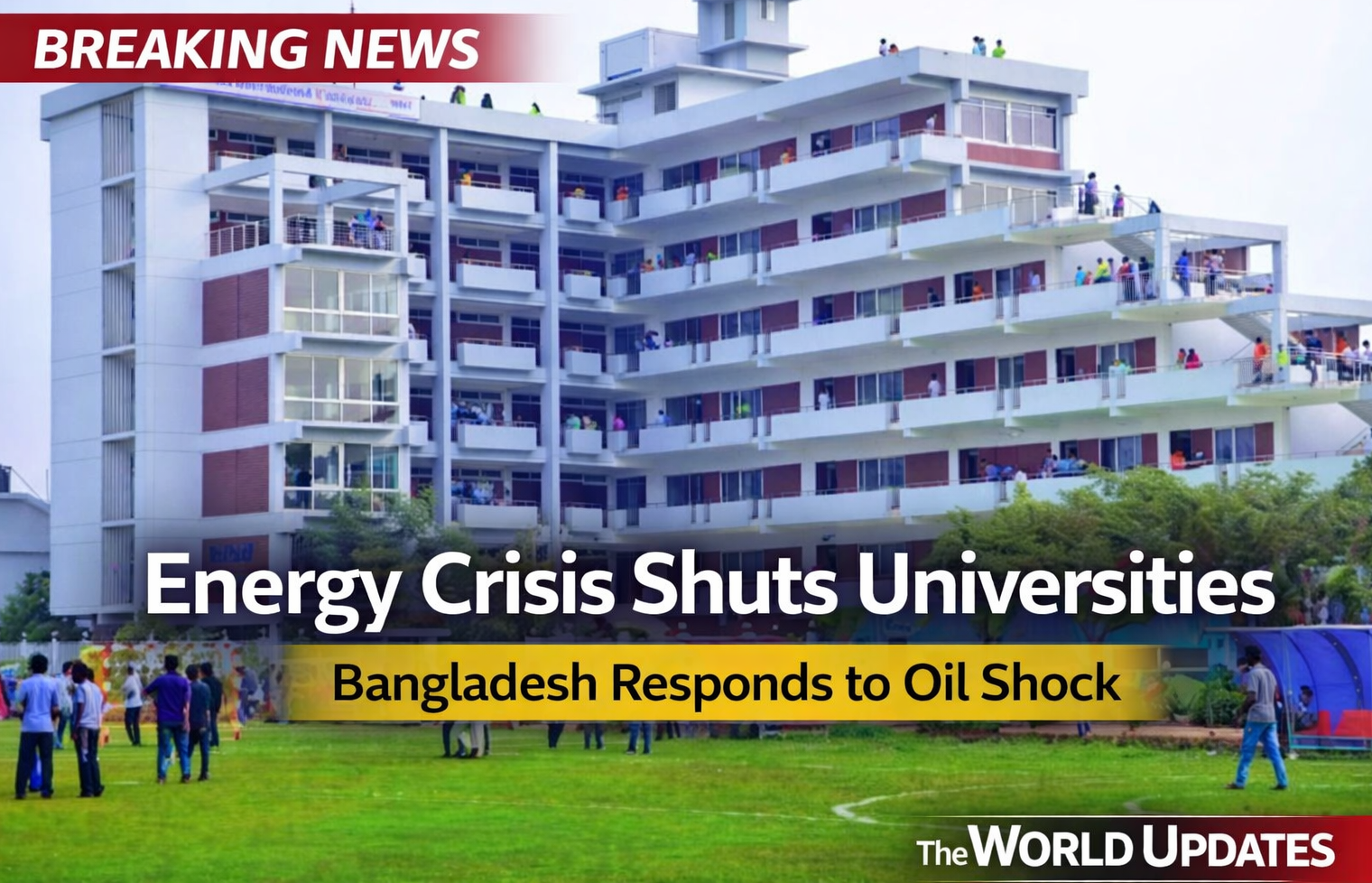
Breaking News: The government of Bangladesh has announced the early closure of universities nationwide as the country struggles to manage an emerging energy crisis linked to the escalating Middle East conflict.
Officials in Dhaka said both public and private universities will remain closed until the upcoming Eid al-Fitr celebrations.
The decision comes as global fuel prices surge following the intensifying confrontation between Iran, the United States, and Israel, raising fears of a wider Middle East conflict and global energy shortage.
Bangladeshi authorities say the move aims to reduce electricity consumption and fuel demand during a period of rising energy costs.
Government Announces Early Holiday to Save Energy
Bangladesh’s education authorities confirmed that all universities across the country will close earlier than scheduled, effectively extending the Eid holidays.
Officials said the measure was introduced as part of emergency energy conservation efforts.
University campuses consume significant electricity due to the operation of classrooms, laboratories, dormitories, and air-conditioning systems.
By suspending academic activities temporarily, the government hopes to ease pressure on the national power grid.
Authorities also expect the closures to reduce transportation demand, thereby lowering fuel consumption across major cities.
Rising Fuel Prices Driving the Energy Crisis
The policy comes as global oil markets face severe disruption due to escalating geopolitical tensions.
Energy prices have surged after Iran reportedly restricted traffic through the Strait of Hormuz, one of the world’s most critical oil shipping lanes.
Nearly 20 percent of global oil supply passes through the strait, making it a vital route for international energy markets.
The closure or disruption of this route has triggered sharp increases in oil prices worldwide.
Developing economies such as Bangladesh, which rely heavily on imported fuel, are particularly vulnerable to such price shocks.
Universities Among Largest Electricity Consumers
Officials say universities are among the largest institutional consumers of electricity in Bangladesh.
Campus operations require power for a wide range of facilities including:
- Lecture halls and academic departments
- Student hostels and residential complexes
- Scientific laboratories and research centers
- Administrative offices
- Cooling systems and air-conditioning
During the hot season, air-conditioning alone can significantly increase electricity demand.
Authorities believe temporary closures will help stabilize electricity supply while reducing operational costs.
Ramadan School Closures Already Underway
The government’s decision follows an earlier policy under which schools across Bangladesh were already closed during the month of Ramadan.
With both schools and universities now closed, officials expect a noticeable drop in national electricity consumption.
Energy experts say similar measures have been adopted in several countries during periods of fuel shortages or energy crises.
Reducing demand from large institutions can help governments avoid power outages during times of limited energy supply.
Global Energy Crisis Spreads Beyond Middle East
Although the conflict is centered in the Middle East, its impact is being felt far beyond the region.
Global oil markets have experienced significant volatility as investors react to the possibility of prolonged disruption in energy supply routes.
Countries in South Asia, Southeast Asia, and parts of Africa depend heavily on imported oil for electricity generation and transportation.
Rising fuel costs therefore place additional pressure on government budgets and household expenses.
Bangladesh’s decision highlights how regional geopolitical tensions can quickly translate into domestic economic challenges.
Governments Seek Emergency Energy Solutions
As oil prices remain volatile, many governments are exploring short-term strategies to manage fuel consumption.
These measures may include:
- Temporary closures of energy-intensive institutions
- Adjusted working hours for government offices
- Increased use of renewable energy sources
- Public campaigns promoting energy conservation
Bangladesh officials say they will continue monitoring the global situation and may introduce additional measures if the crisis persists.
For now, authorities hope the early Eid holiday will help ease pressure on the country’s electricity and fuel systems.