

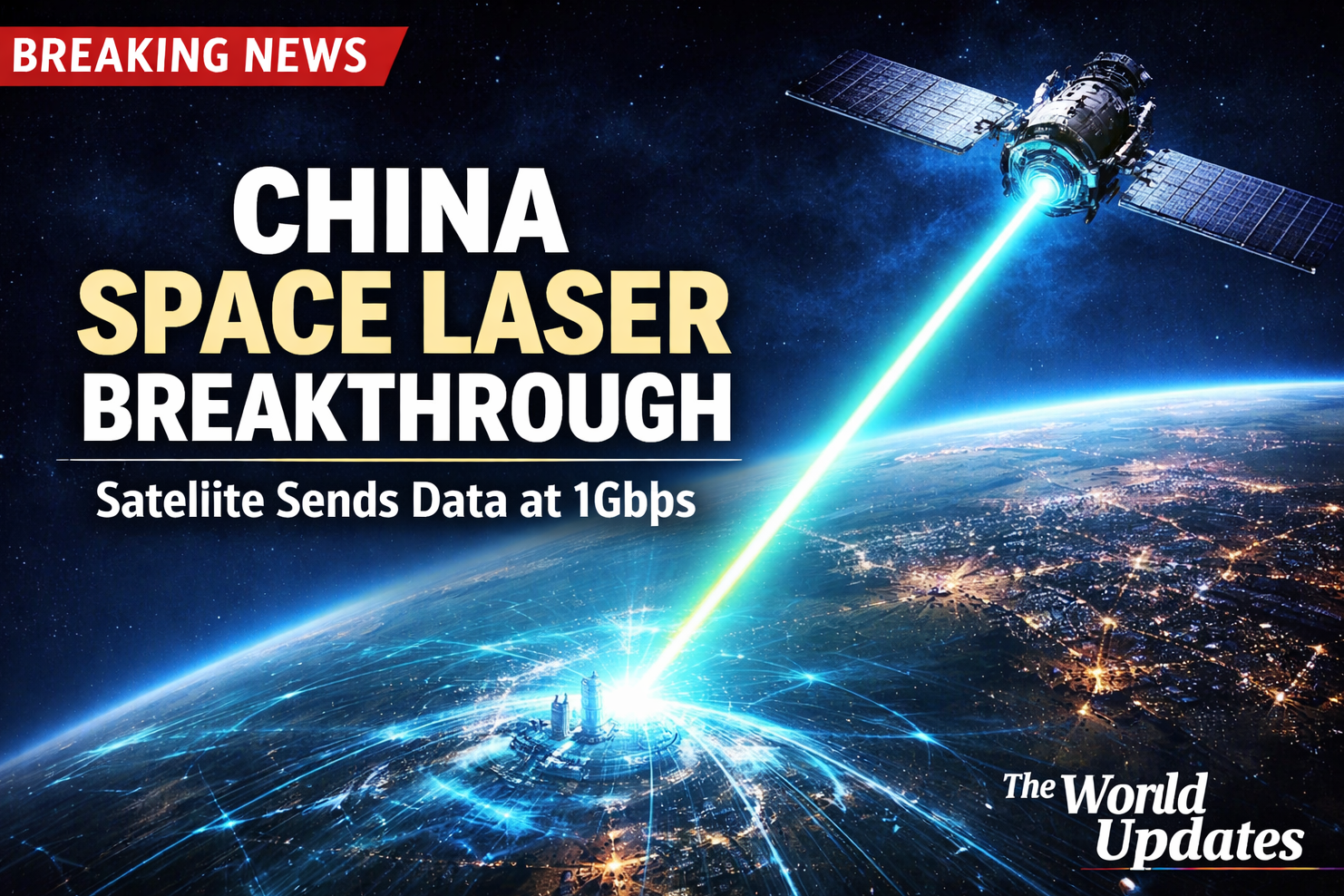
New Laser Link Sends Data from Space at 1 Gigabit per Second
China has announced a major advance in satellite communication technology after scientists successfully tested a high-speed satellite-to-ground laser link capable of transmitting data at 1 gigabit per second across a distance of more than 40,000 kilometres.
The breakthrough marks an important step in the development of next-generation space communication systems designed to handle rapidly growing global data demands.
Researchers conducted the experiment using a geosynchronous satellite and a ground observatory located in southwestern China. During the two-day test, the system maintained a stable laser communication connection between the satellite in high orbit and the ground station.
Scientists say the achievement could significantly improve space-based communications, remote sensing systems, and future deep-space missions.
Breakthrough Demonstrates High-Speed Laser Data Transfer from Space
The project focused on testing advanced satellite-to-ground laser communication technology capable of delivering extremely fast data transmission from orbit.
According to researchers involved in the experiment, the system achieved continuous data transfer at speeds of around 1 gigabit per second.
The laser link connected a high-orbit satellite with an observatory located in Yunnan Province in southwestern China. Engineers successfully maintained the connection across a distance exceeding 40,000 kilometres.
The experiment demonstrated that laser communication can support large volumes of data transmission while maintaining high reliability in challenging space environments.
Experts say such capabilities will become increasingly important as satellites collect larger amounts of information from Earth observation, climate monitoring, and global communications systems.
Collaboration Between Leading Chinese Research Institutions
The research project resulted from a collaboration between the Chinese Academy of Sciences’ Institute of Electronics and the Beijing University of Posts and Telecommunications.
Scientists from both institutions worked together to design and test the laser communication system, which relies on highly precise optical technology.
Unlike traditional radio frequency communication, laser systems transmit data through tightly focused beams of light.
This approach allows satellites to send information much faster while using less bandwidth and power.
Researchers say the technology also offers higher security and reduced signal interference compared with conventional satellite communication systems.
Laser Communication Could Transform Satellite Operations
The successful test may change how high-orbit satellites operate in the future.
Traditionally, many satellites act mainly as data relay systems that transmit collected information to Earth.
However, laser communication technology could allow satellites to operate more like intelligent processing hubs.
According to scientists involved in the research, the new system enables satellites not only to send data quickly but also to receive complex instructions from Earth in real time.
This two-way communication capability could allow satellites to perform more advanced tasks directly in orbit.
Engineers believe this could improve the efficiency of satellite networks used for Earth observation, navigation, climate research, and global communications.
Laser Technology Offers Massive Bandwidth Advantages
One of the key advantages of laser communication lies in its ability to deliver dramatically higher bandwidth compared with traditional radio-frequency systems.
Researchers involved in the project say laser communication can provide up to 1,000 times the bandwidth of conventional satellite communication technologies.
This improvement helps solve one of the biggest challenges facing modern satellite systems: managing huge volumes of data generated by high-resolution sensors.
Modern satellites capture vast amounts of imagery and scientific data every day. Transmitting that information quickly and efficiently to ground stations remains a major technical challenge.
Laser communication systems could significantly reduce these data bottlenecks and enable faster analysis of information collected from space.
Potential Applications in Remote Sensing and Deep-Space Missions
Scientists believe the technology will play an important role in future space exploration and global monitoring systems.
High-speed communication links could improve the performance of remote sensing satellites that monitor weather patterns, environmental changes, and natural disasters.
Such systems generate massive datasets that require fast and reliable transmission to ground stations.
In addition, researchers say laser communication technology could support future deep-space missions by enabling faster communication between spacecraft and Earth.
Recent experiments have already demonstrated the ability of ground stations to support long-distance optical communication links.
These developments could help create a new generation of space networks designed to handle increasingly complex missions.
Growing Global Competition in Space Communication Technology
China’s latest achievement highlights the intensifying global competition in space technology and satellite communications.
Countries around the world are investing heavily in next-generation satellite networks capable of delivering faster data transmission and improved connectivity.
High-speed space communication systems are expected to support a wide range of applications, including climate monitoring, scientific research, global internet services, and defense operations.
As satellite networks become more advanced, technologies such as laser communication could become essential infrastructure for future space systems.
Researchers say continued testing and development will be necessary before large-scale deployment of the technology becomes possible.
However, the recent experiment provides strong evidence that high-speed laser communication could soon become a central component of next-generation space communication networks.