
Beijing Signals Economic Caution During Major Political Gathering
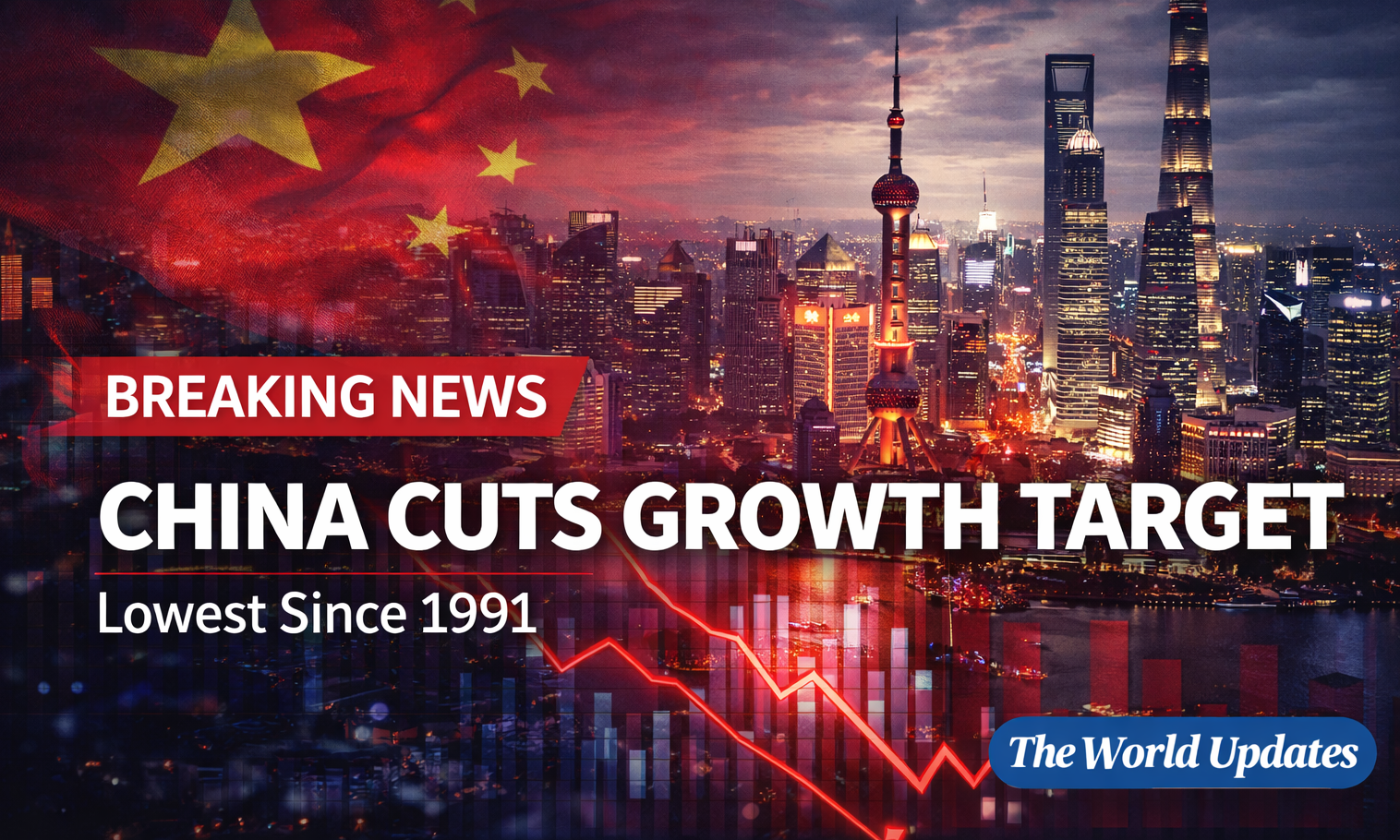
China has set its lowest economic growth target since 1991, lowering its expansion goal to 4.5%–5% as the world’s second-largest economy faces mounting domestic and international challenges.
The announcement came during China’s annual political meetings known as the “Two Sessions,” where top leaders outline national priorities and economic plans for the coming years.
Premier Li Qiang presented the updated target while unveiling elements of the country’s 15th Five-Year Plan, a strategic blueprint expected to guide China’s development toward 2030.
Economists say the revised growth target reflects Beijing’s attempt to manage slowing economic momentum while adapting to complex global conditions.
Domestic Economic Challenges Drive Policy Shift
China’s economy has faced multiple pressures in recent years, including weak domestic consumption, demographic decline, and a prolonged crisis in the property sector.
Official data earlier this year showed China achieved 5% growth in 2025, but expansion slowed to 4.5% in the final quarter, highlighting structural weaknesses in the economy.
A prolonged downturn in the real estate sector has weighed heavily on consumer confidence and local government finances.
For years, property development accounted for nearly one-third of China’s economic activity, making it one of the country’s most critical economic engines.
However, falling property prices, rising developer debt and declining demand have triggered layoffs and reduced household spending across the country.
Analysts say these challenges have forced policymakers to adopt a more cautious growth outlook.
Flexible Growth Target Offers Policy Room
Some economists argue the lower growth target gives China more flexibility in managing its economy.
Jason Bedford of the East Asian Institute said flexible targets allow Beijing to stabilize economic conditions without resorting to excessive stimulus spending.
He noted that China previously used flexible economic targets during the COVID-19 pandemic, although such a strategy is not typically the norm.
By setting a broader range instead of a single figure, Beijing may avoid heavy government spending solely to meet a fixed target.
Policy analysts say this approach could allow authorities to focus on structural reforms rather than short-term growth boosts.
China Focuses on Innovation and Technology
Premier Li Qiang told delegates that the new Five-Year Plan will prioritize technological innovation, high-tech industries and scientific research.
Beijing aims to accelerate the development of advanced manufacturing sectors such as artificial intelligence, renewable energy, and semiconductor production.
The government also plans to launch more than 100 major infrastructure and industrial projects over the next five years.
These initiatives will focus on areas including transportation, energy systems and advanced manufacturing capabilities.
China’s leadership believes strengthening domestic innovation will reduce reliance on foreign technology and strengthen economic resilience.
Boosting Domestic Consumption Becomes Priority
Another key objective of China’s economic strategy is increasing domestic consumption.
Policymakers believe the economy remains too dependent on exports, leaving it vulnerable to global economic fluctuations.
To address this imbalance, the government plans to introduce policies aimed at increasing household income and encouraging consumer spending.
Measures under discussion include improvements in healthcare, education and employment conditions.
Officials also plan to create what they describe as a “childbirth-friendly society,” addressing declining birth rates and an aging population.
China’s shrinking workforce presents a long-term challenge to economic growth and productivity.
Trade Tensions and Global Pressures
China’s economic outlook also faces external pressures, particularly from global trade tensions.
Tariffs imposed by Donald Trump have increased pressure on China’s export-driven manufacturing sector.
Although China recorded a record trade surplus of $1.19 trillion last year, economists warn that heavy reliance on exports creates vulnerability to geopolitical shifts.
Analysts say Beijing has been redirecting trade toward other markets to sustain its manufacturing output.
However, the broader global environment remains uncertain as trade disputes continue to shape economic policy worldwide.
Energy and Geopolitical Risks Add Pressure
China’s energy security has also become a growing concern.
Recent geopolitical developments have disrupted key oil supply routes, increasing pressure on China’s energy imports.
Conflicts involving Iran and broader instability in global energy markets have complicated China’s supply chains.
These developments have forced Beijing to accelerate investments in renewable energy and energy independence.
Premier Li’s report emphasized a stronger push toward green energy and carbon reduction initiatives, aligning with China’s long-term environmental commitments.
Analysts Say Target Reflects Realism
Economic experts say the new growth target reflects a more realistic outlook for China’s economy.
Zhou Zheng, a policy analyst at China Macro Group, said the government appears to be acknowledging structural challenges while focusing on sustainable growth.
He noted that China continues to face complex economic issues that require long-term solutions rather than short-term stimulus.
However, some analysts caution that official growth figures may not fully capture the depth of economic challenges.
Researcher Ning Leng from Georgetown University said China’s economic data should be interpreted carefully, noting that other indicators suggest slower underlying growth.
Global Impact of China’s Economic Strategy
As the world’s second-largest economy, China’s growth trajectory carries significant global implications.
Changes in China’s economic policy can influence global supply chains, commodity markets and international trade patterns.
Many countries depend heavily on Chinese manufacturing and consumer demand.
As Beijing adjusts its growth strategy, economists expect ripple effects across global markets and emerging economies.
The coming years will test whether China can successfully transition toward a more innovation-driven and consumption-based economic model.