
Beijing says territory belongs to China as tensions resurface over Kashmir region
A fresh diplomatic dispute has emerged between China and India after Beijing firmly rejected New Delhi’s claim over the strategically significant Shaksgam Valley in the wider Kashmir area.
China’s Foreign Ministry stated that the valley is part of Chinese territory and defended its right to carry out infrastructure projects in the region.
The statement came in response to criticism from India, which accused Beijing of attempting to alter the “ground realities” in what New Delhi considers its territory.
The disagreement highlights the continuing geopolitical tensions between the two Asian powers despite recent efforts to improve relations.
China Defends Construction Activities in Shaksgam Valley
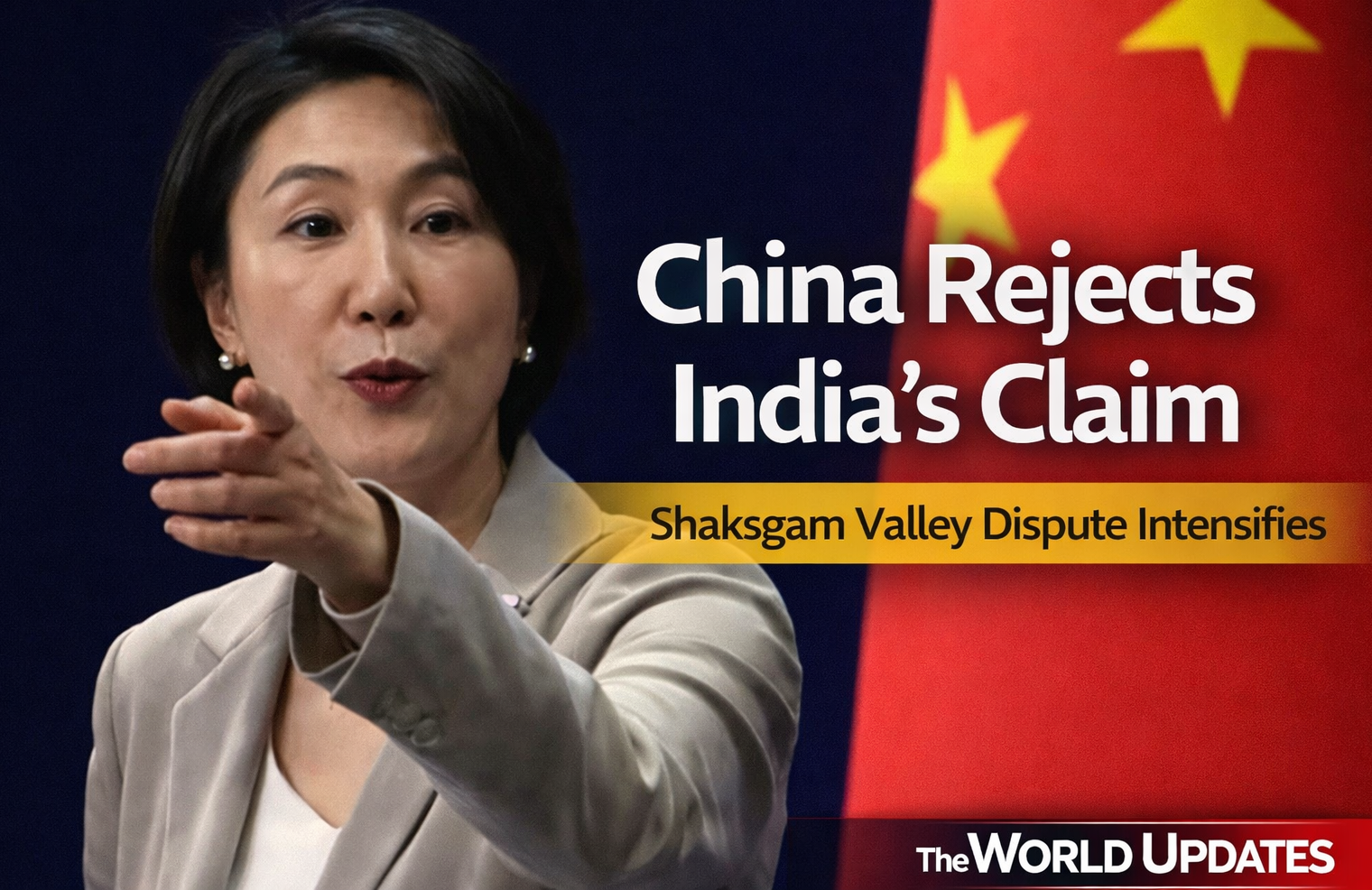
During a regular press briefing in Beijing, Chinese Foreign Ministry spokesperson Mao Ning addressed questions about India’s objections to China’s infrastructure projects in the valley.
Mao Ning said China has every right to carry out construction and development projects on its own territory.
She emphasized that the area mentioned by India is part of China’s sovereign territory.
According to Beijing, the boundaries of the region were established through a bilateral agreement signed between China and Pakistan during the 1960s.
Chinese officials argue that sovereign states have the right to determine and demarcate their borders through mutual agreements.
India Rejects 1963 China–Pakistan Border Agreement
The latest exchange of statements follows remarks by India’s Ministry of External Affairs.
Indian officials reiterated that New Delhi does not recognize the 1963 China–Pakistan border agreement, under which the Shaksgam Valley was administratively transferred to China.
India considers the agreement illegal and void, arguing that the territory is part of the wider Jammu and Kashmir region.
New Delhi has also criticized China’s development activities in the region, saying they attempt to change the status quo on the ground.
Indian officials have repeatedly stated that Jammu and Kashmir and Ladakh are integral parts of India.
They maintain that the government reserves the right to protect its territorial interests.
China-Pakistan Economic Corridor Also Under Scrutiny
India also continues to oppose the China–Pakistan Economic Corridor, a major development initiative linking western China to Pakistan’s Arabian Sea port of Gwadar.
The corridor forms a central part of Belt and Road Initiative.
India argues that parts of the project pass through territories it claims in Kashmir.
China, however, insists that the corridor is purely an economic development initiative designed to improve regional infrastructure and economic growth.
Chinese officials say the project benefits local communities and enhances regional connectivity.
Longstanding Border Disputes Between China and India
The dispute over the Shaksgam Valley is part of a broader history of border tensions between China and India.
The two countries share a disputed Himalayan border stretching over 3,400 kilometers.
One of the most serious recent incidents occurred in 2020, when clashes between troops in the Galwan Valley resulted in the deaths of 20 Indian soldiers and four Chinese soldiers.
The incident marked the deadliest confrontation between the two countries in decades.
Efforts to Reduce Tensions in Recent Years
Despite historical tensions, both governments have attempted to stabilize relations in recent years.
In 2024, Beijing and New Delhi reached a significant agreement aimed at reducing military tensions along parts of the Himalayan border.
The agreement included measures such as disengagement of troops in certain areas and enhanced communication between military commanders.
Diplomatic efforts also led to discussions about restoring direct flights, increasing trade cooperation, and encouraging investment ties between the two countries.
However, territorial disputes continue to create periodic diplomatic friction.
Arunachal Pradesh Remains Another Flashpoint
In addition to the Shaksgam Valley dispute, China and India remain divided over Arunachal Pradesh.
Beijing refers to the region as Zangnan, claiming it as part of southern Tibet.
India strongly rejects these claims and administers the region as a full state of the Indian union.
China’s periodic renaming of locations within the area has also triggered strong reactions from New Delhi.
Regional Stability and Geopolitical Implications
Analysts say the renewed diplomatic dispute highlights the delicate balance of power in Asia.
While China and India remain major economic partners, unresolved territorial disputes continue to influence strategic relations.
The Shaksgam Valley issue also intersects with the broader Kashmir conflict involving Pakistan, adding further complexity to regional geopolitics.
Experts warn that although both sides prefer diplomatic solutions, unresolved border disputes could continue to generate tensions.
For now, the latest statements underscore how sensitive territorial claims remain in one of the world’s most geopolitically significant regions.